Why Safe AI Matters for Manufacturing SMEs
Artificial Intelligence (AI) is transforming manufacturing through predictive maintenance, quality control, automation, supply chain optimisation, machine vision, and intelligent decision-making.
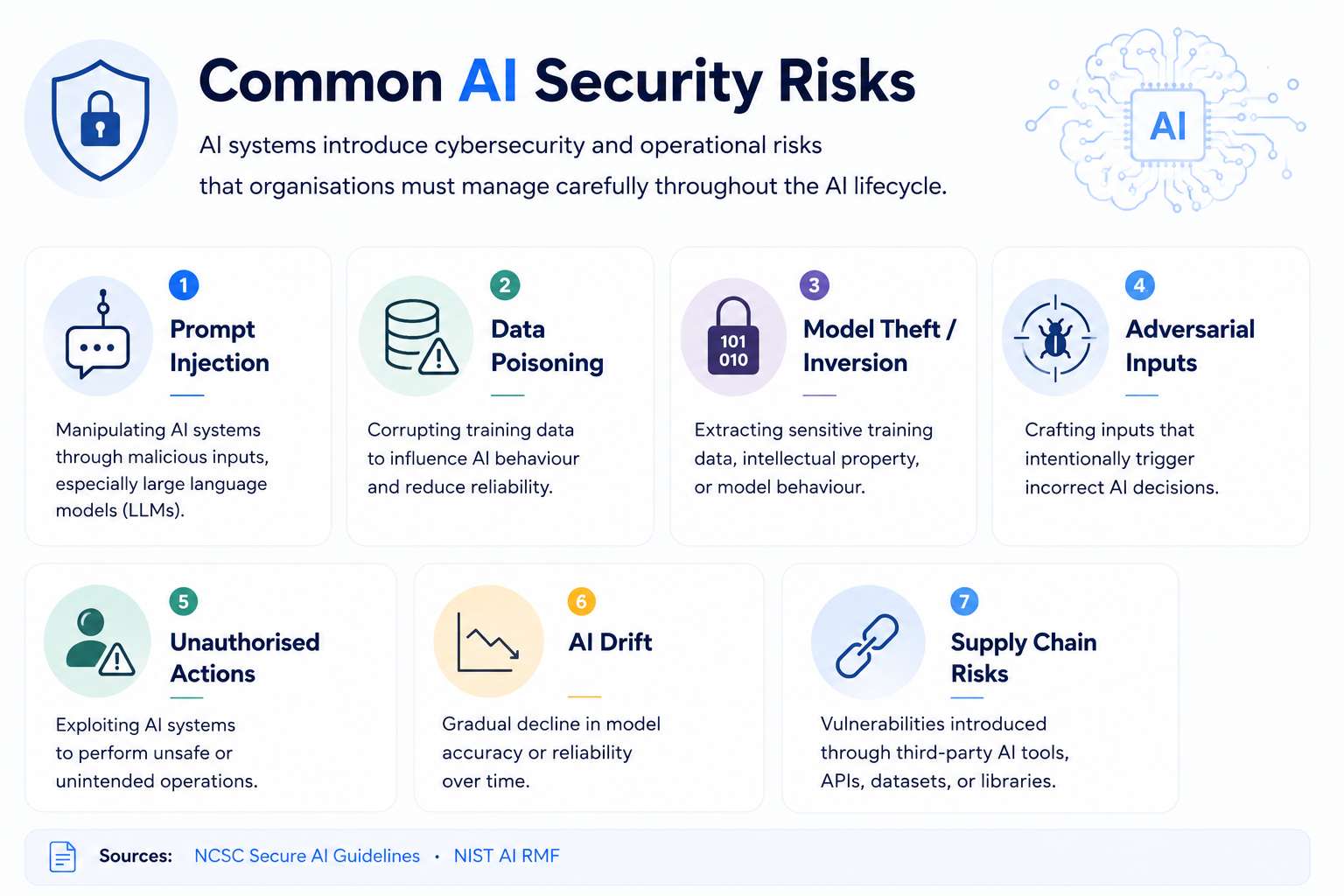
However, AI systems also introduce new cybersecurity and operational risks that organisations must manage carefully. Without secure and responsible implementation, AI can create vulnerabilities affecting production, safety, intellectual property, compliance, and business continuity.
For manufacturing SMEs across Greater Manchester and the Northwest, adopting AI securely is essential for building resilient, sustainable, and future-ready operations aligned with Industry 5.0 principles.
AI Opportunities
- Predictive maintenance
- Quality control
- Automation
- Supply chain optimisation
- Faster operational insights
AI Risks
- Data poisoning
- Prompt injection
- AI drift
- Model manipulation
- Operational disruption
Cybersecurity is a necessary foundation for AI safety, resilience, privacy, fairness, reliability, and trustworthiness.
What is Safe AI?
Safe AI means using artificial intelligence in a way that is secure, reliable, transparent and accountable from design through to deployment, day-to-day use and ongoing review. Safe AI is concerned not only with the quality of outputs, but also with how an AI system operates, how decisions can be explained, who is accountable for its use, and what safeguards exist if problems occur.
For manufacturing SMEs, Safe AI means applying those principles to real operational settings such as quality inspection, scheduling, maintenance, customer support and document workflows. In practice, that includes protecting commercially sensitive data, managing cyber risk, checking that outputs are accurate enough for the task, and making sure people remain involved when AI could affect production, safety, quality or compliance.
Taking a structured approach to Safe AI allows organisations to identify risks early, apply appropriate controls and monitor systems throughout their lifecycle. This helps reduce operational, security and compliance risks while supporting more confident adoption of AI technologies.
Sources: NCSC Secure AI Guidelines · Information Commissioner's Office (ICO) · UK Government AI Regulation
Understanding AI Threats
UK AI Security Institute (AISI)
The UK AI Security Institute (AISI) helps organisations understand and respond to emerging AI safety and security risks. It shares research, model evaluation insights, and updates on how AI risks are changing.
Understand Risks
Keep up with emerging AI security threats, misuse risks, and system vulnerabilities.
Learn from Testing
Use AISI updates to understand how advanced AI systems are evaluated and tested.
Support SMEs
Help North West manufacturing SMEs make safer decisions when adopting AI tools.
AISI Blog
Follow the latest AI safety research, risk updates, and publications from the UK AI Security Institute.
Source: UK AI Security Institute (AISI)
The Four Stages of Secure AI Adoption
Secure Design
Plan risks early
Development
Protect data and models
Deployment
Launch safely
Maintenance
Monitor and improve
Plan Before You Buy or Build
Raise awareness of AI-specific cyber risks, conduct threat modelling, assess suppliers, and apply secure-by-design principles.
SME Tip: Start with clearly defined business problems instead of adopting AI simply because it is trending.
Protect Data, Models, and Infrastructure
Vet suppliers, protect proprietary data, maintain documentation (Model Cards, SBOMs), and manage technical debt.
SME Tip: A lack of supplier transparency is a major warning sign. Always request documentation and security assurances.
Launch AI Safely and Responsibly
Secure infrastructure, conduct thorough testing (including red teaming), and prepare AI-specific incident response plans.
SME Tip: Start with small-scale pilots before wider rollout across production environments.
Maintain AI Security Throughout the Lifecycle
Monitor for anomalies and drift, test updates, maintain logs, and continuously review risks.
SME Tip: Include AI systems within standard maintenance and cyber risk management processes.
Safe AI Readiness Self-Check for SMEs
Score each statement from 1 (Not started) to 5 (Fully in place). This helps you identify where your organisation may need stronger AI governance, security, or human oversight.
Your Safe AI Readiness Score: 0/40
Select a score for each statement to see your readiness level.
Understanding Adversarial Machine Learning (AML)
Adversarial Machine Learning (AML) refers to attacks specifically designed to manipulate, exploit, or interfere with artificial intelligence systems. These attacks target the behaviour, data, or decision-making processes of machine learning models.
In manufacturing environments, adversarial attacks may affect operational reliability, production quality, automation systems, and business continuity.
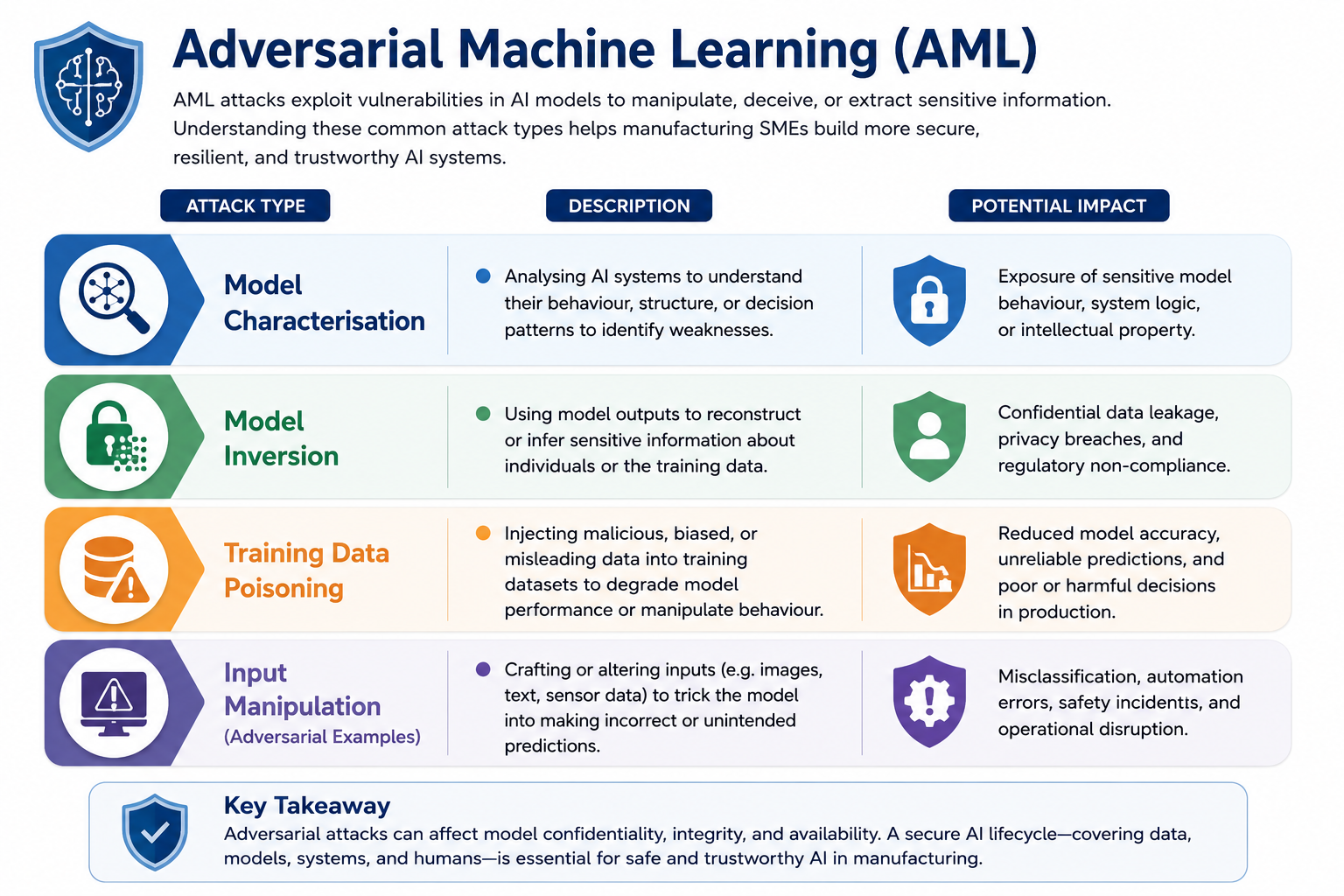
Understanding adversarial AI risks helps manufacturing SMEs strengthen threat modelling, improve resilience, and adopt AI technologies more securely.
Sources: NCSC AI Security Collection · NIST Adversarial Machine Learning Taxonomy
Secure by Design and Secure by Default
Secure AI systems should be designed with security as a core requirement from the beginning, rather than adding protections after deployment. This approach is commonly referred to as Secure by Design.
Secure by Default means systems should already include safe and secure configurations when first deployed, reducing the likelihood of misconfiguration and lowering operational risk.
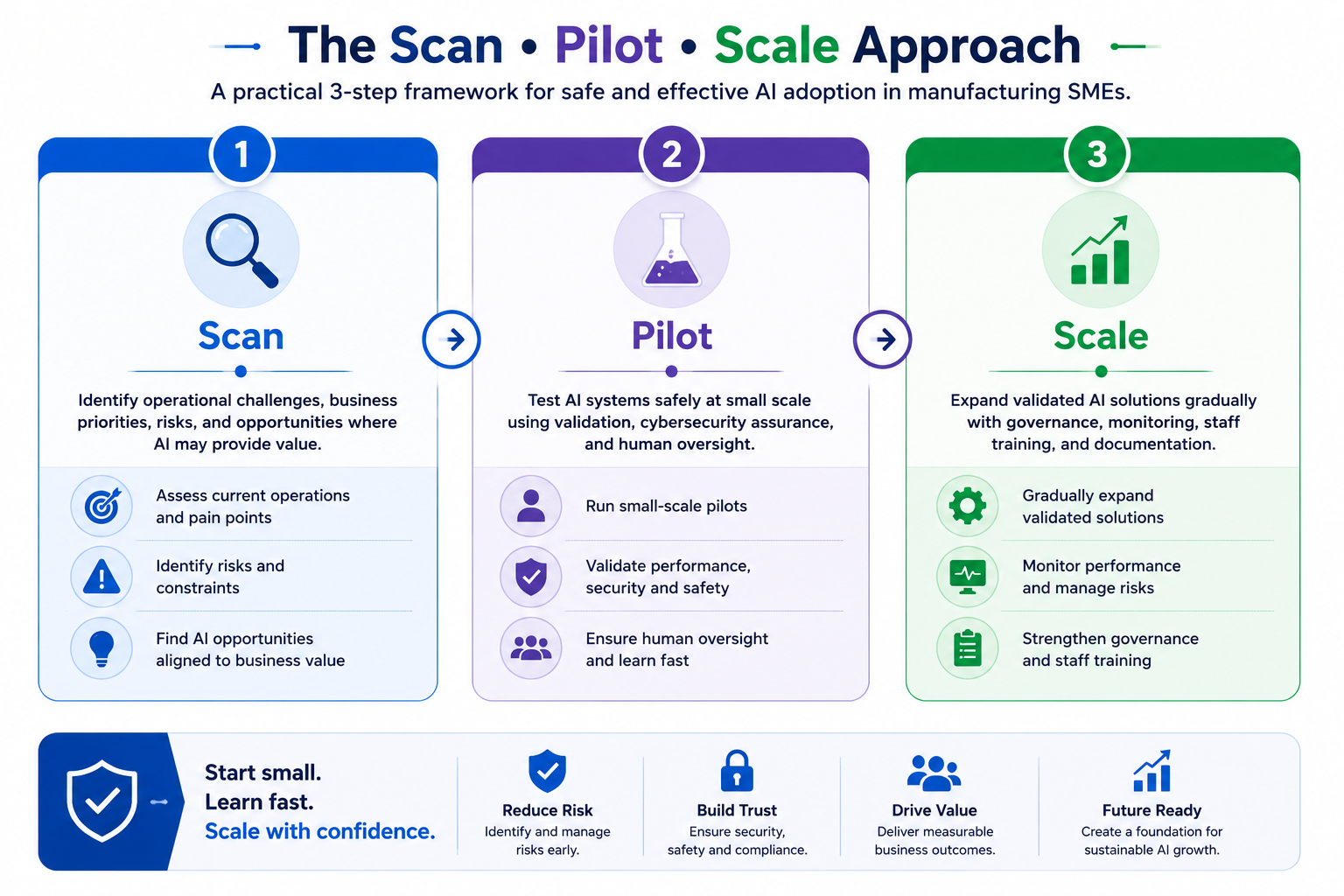
For manufacturing SMEs, these approaches help improve operational resilience, reduce avoidable vulnerabilities, and support safer long-term AI adoption.
Source: CISA Secure by Design Guidance
AI in Manufacturing: Practical Adoption Approach
Successful AI adoption should focus on solving real operational problems rather than using AI for its own sake. For manufacturing SMEs, a phased approach helps reduce risk and build confidence before wider deployment.
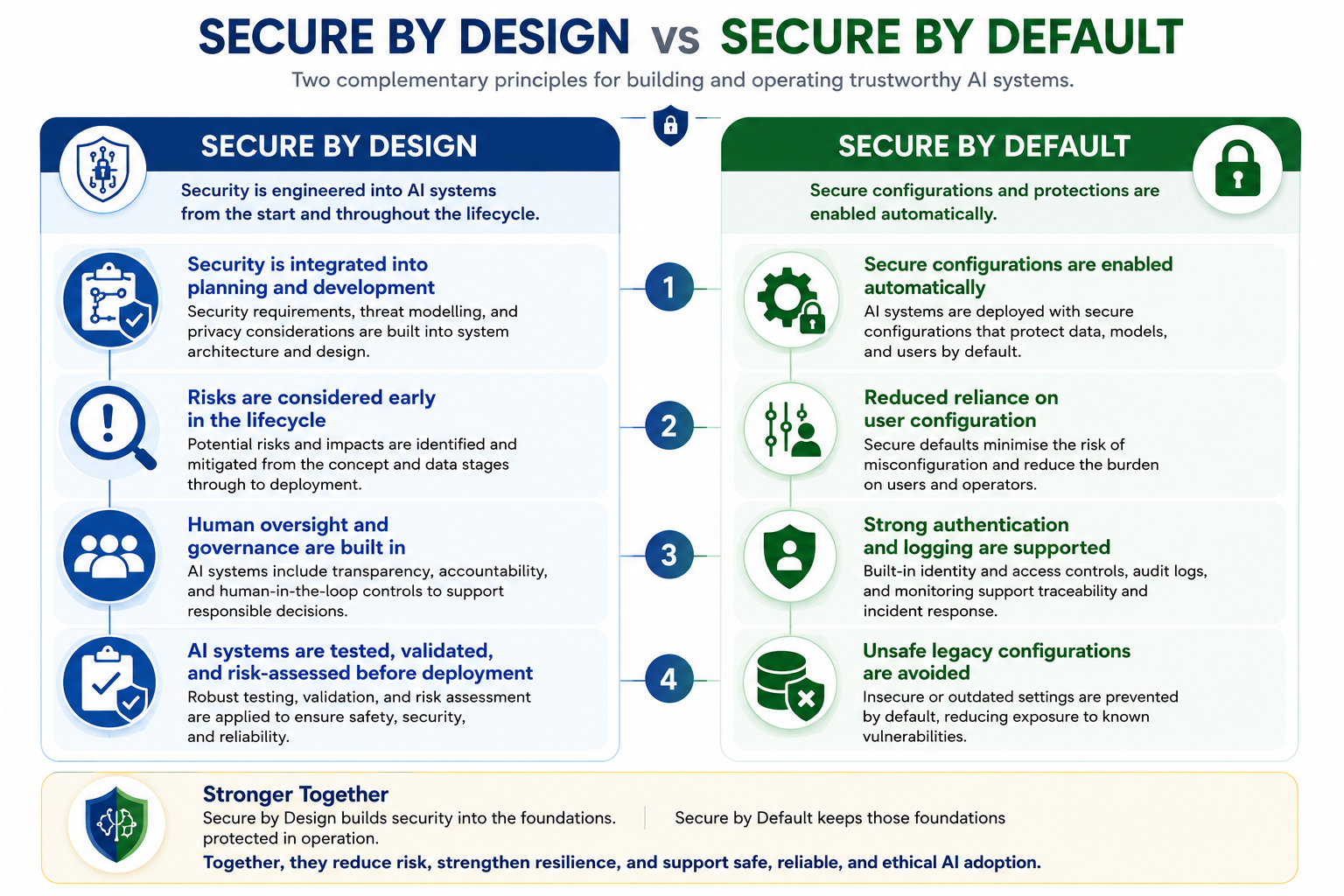
This approach supports responsible AI adoption by helping SMEs validate benefits, manage risks, and embed AI into existing workflows safely.
Source: Made Smarter UK
Trustworthy AI and Risk Management
Trustworthy AI refers to AI systems that are secure, reliable, transparent, and accountable throughout their lifecycle. Effective AI risk management helps organisations reduce operational, cybersecurity, and governance risks while improving confidence in AI technologies.
Scroll sideways to explore the four trustworthy AI principles →
Safety
AI systems should be designed and managed to minimise risks to people, operations, and infrastructure.
Security
Systems should resist cyber attacks, manipulation, and operational failures.
Transparency
Organisations should understand how AI systems operate and make decisions.
Accountability
Clear responsibility and oversight should exist for AI outcomes and decisions.
Applying trustworthy AI principles helps manufacturing SMEs improve resilience, support safer adoption, and maintain confidence in AI-driven systems.
Sources: NIST AI RMF · UK AI Regulation
A General AI Readiness Toolkit for Manufacturing SMEs
Before adopting AI technologies, manufacturing SMEs should assess whether they are operationally, technically, and organisationally prepared. This toolkit provides a practical starting point for evaluating AI readiness and identifying areas requiring improvement before deployment.
- Have we identified a clear operational problem AI could help solve?
- Do we understand the expected business value?
- Have we considered operational risks and limitations?
- Do staff understand why AI is being introduced?
- Do we have reliable and accurate data?
- Is sensitive information properly protected?
- Have cybersecurity controls been reviewed?
- Can existing systems safely integrate with AI tools?
- Who is responsible for AI oversight?
- Are staff trained to review AI outputs?
- Do humans remain involved in important decisions?
- Do we understand supplier responsibilities and limitations?
- Have supplier security practices been reviewed?
- Do suppliers provide documentation and transparency?
- Have AI risks been assessed before deployment?
- Is incident response planning in place?
Download the AI Readiness Toolkit
Use this checklist to assess whether your organisation is ready to adopt AI safely and responsibly.
Sources: Made Smarter UK · NCSC Secure AI Guidelines
ICO AI & Data Protection Risk Toolkit
The Information Commissioner’s Office (ICO) AI and Data Protection Risk Toolkit helps organisations assess and manage data protection risks when designing, procuring, or deploying AI systems.
The toolkit supports organisations with practical governance, accountability, privacy, and GDPR considerations throughout the AI lifecycle.
- Assessing AI-related privacy and GDPR risks
- Identifying governance and accountability gaps
- Reviewing fairness, transparency, and human oversight
- Supporting responsible AI deployment decisions
- Documenting compliance and risk mitigation actions
Download the ICO AI Risk Toolkit
Practical spreadsheet toolkit for assessing AI and data protection risks within organisations.
Scan → Pilot → Scale Implementation Guide
This guide helps manufacturing SMEs move from an AI idea to a controlled pilot and then to wider adoption. The aim is to test AI safely, measure value, and reduce operational risk before scaling.
- Identify one clear operational problem or improvement area.
- Check whether AI is genuinely needed or whether simpler automation is enough.
- Review available data, system readiness, staff capability, and cyber risks.
- Define what success would look like before selecting a tool or supplier.
- Run the AI system in a limited, controlled environment.
- Keep human oversight in place for important outputs or decisions.
- Test accuracy, reliability, security, usability, and operational impact.
- Record issues, limitations, false outputs, and staff feedback.
- Scale gradually after the pilot has shown clear value and acceptable risk.
- Document ownership, monitoring, maintenance, and escalation procedures.
- Train staff before wider deployment.
- Review performance regularly and prepare rollback plans if problems occur.
Scan and Scale: Comparison of Key Actions
The table below is designed to help readers see the difference between early-stage validation and wider operational rollout.
Sources: NCSC Guidelines for Secure AI System Development · NIST AI Risk Management Framework
Download the Scan → Pilot → Scale Guide
Use this guide to plan, test, and scale AI solutions safely before wider rollout.
Source: Made Smarter UK
AI Vision Inspection Example
A manufacturer wants to use AI vision inspection to detect surface defects on finished parts. Before deployment, the business should confirm the inspection goal, test whether the image data is good enough, review supplier security and support, document known limitations, and decide when a human inspector must overrule the system.
If the cameras or workflow capture people, IDs or other personal data, the organisation should also assess its data protection obligations.
- Define the defect types, acceptable tolerance levels and what counts as a pass, fail or manual review case.
- Validate images from real operating conditions, including different lighting, angles, speeds and product variants.
- Check data governance, supplier security, model versioning and fallback procedures if the system fails or becomes unavailable.
- Start on one line or one product family with protected access controls, audit logs and a documented escalation route.
- Require operators or quality engineers to review borderline or high-impact cases rather than allowing the model to act alone.
- Compare AI decisions with human inspection results to confirm the pilot is performing as expected in live conditions.
- Monitor false positives, false negatives, drift and override rates over time.
- Reassess performance when new materials, finishes, lighting conditions or camera settings are introduced.
- Review incidents and lessons learned, then retrain, restrict or retire the model if it no longer meets safety, quality or compliance expectations.
Sources: NCSC Guidelines for Secure AI System Development · Information Commissioner's Office (ICO) · NIST AI Risk Management Framework
Common SME Mistakes When Adopting AI
Avoiding common implementation mistakes can help manufacturing SMEs reduce unnecessary security, operational and governance risks when introducing AI.
Choosing an AI tool before defining the business problem
Mitigation: Begin with one operational pain point, one measurable outcome and one named owner.
Putting confidential data into public or poorly governed AI tools
Mitigation: Set clear acceptable-use rules, restrict data access and check where data is processed and stored.
Buying from suppliers without enough due diligence
Mitigation: Assess security, transparency, support, incident handling and contract terms before purchase.
Assuming pilot accuracy will hold at full scale
Mitigation: Expand gradually and retest when products, processes, environments or users change.
Removing human review too early
Mitigation: Keep people in the loop for decisions that affect safety, quality, customers or compliance.
Failing to monitor for drift, unexpected behaviour or misuse
Mitigation: Log inputs and outputs, track overrides and review incidents and updates on a regular schedule.
Treating AI output as fact without verification
Mitigation: Require checks for high-impact outputs, especially where generative AI could produce inaccurate or misleading content.
AI Supplier Assessment Checklist
Before adopting an external AI tool, platform, or service, manufacturing SMEs should assess whether the supplier can demonstrate safe, secure, and transparent practices. This checklist helps identify supplier risks before purchase or deployment.
- Does the supplier clearly explain what the AI system does and does not do?
- Are model limitations, assumptions, and intended use cases documented?
- Can the supplier explain how outputs should be interpreted by staff?
- Is there clear guidance on when human review is required?
- What data will the AI system collect, process, or store?
- Is sensitive business, production, customer, or supplier data protected?
- Does the supplier explain how data is secured, retained, and deleted?
- Are access controls, logging, encryption, and secure configuration supported?
- Has the system been tested in manufacturing or similar operational environments?
- What happens if the AI system produces incorrect or unreliable outputs?
- Does the supplier provide support, updates, and incident response guidance?
- Can the system be safely paused, rolled back, or removed if needed?
- Who is responsible for monitoring the system after deployment?
- Does the supplier provide documentation for audit, compliance, and risk review?
- Are responsibilities clearly defined between the SME and supplier?
- Are supplier claims supported by evidence rather than marketing language?
Practical Use
SMEs can use this checklist during procurement, supplier meetings, AI demos, and contract discussions.
Sources: NCSC Secure AI Guidelines · CISA Secure by Design
AI Risk Assessment Template
Before deploying AI systems, manufacturing SMEs should assess operational, cybersecurity, safety, and governance risks. This template provides a simple framework for documenting AI-related risks and mitigation actions.
- What operational problem is the AI system solving?
- Which departments, systems, or processes are affected?
- What decisions or outputs will the AI influence?
- Will the system interact with operational technology (OT) or production environments?
- Could incorrect AI outputs disrupt operations or production?
- Could attackers manipulate inputs, outputs, or training data?
- Is sensitive business or customer data exposed?
- Could supplier compromise introduce additional risks?
- Who reviews or approves important AI outputs?
- Can staff override or stop unsafe AI behaviour?
- Are monitoring, logging, and alerts enabled?
- Are rollback and incident response procedures documented?
- Who owns the AI system internally?
- How often will risks and performance be reviewed?
- Are supplier responsibilities clearly defined?
- Have acceptable risk levels been agreed before deployment?
Practical Use
SMEs can use this template during AI planning, procurement, governance reviews, and deployment approvals.
Sources: NIST AI RMF · NCSC Secure AI Guidelines
Human Oversight and Responsible AI Guide
Human oversight is an essential part of safe and responsible AI adoption. Manufacturing SMEs should ensure that staff remain involved in reviewing important AI outputs, managing risks, and responding to unexpected behaviour.
- Ensure humans review important operational or safety-related AI outputs.
- Avoid fully autonomous decisions in high-risk environments.
- Define situations where human approval is mandatory.
- Ensure staff understand when AI outputs should be challenged or escalated.
- Train staff to understand AI limitations and risks.
- Ensure teams recognise inaccurate, biased, or unsafe outputs.
- Provide guidance for reporting AI-related issues.
- Promote responsible and secure AI usage practices.
- Define escalation procedures for unsafe or unexpected AI behaviour.
- Ensure staff know how to disable or pause AI systems if required.
- Maintain incident response procedures covering AI-related failures.
- Record and review incidents to improve resilience over time.
- Assign internal ownership for AI governance and oversight.
- Maintain documentation for decisions, reviews, and updates.
- Review AI performance regularly with human oversight.
- Ensure suppliers and internal teams understand their responsibilities.
Practical Use
SMEs can use this guide to support safer AI governance, staff awareness, and operational oversight during AI adoption.
Sources: NIST AI RMF · UK AI Regulation White Paper
Further Resources
The following resources provide further guidance on secure AI development, trustworthy AI, adversarial machine learning, and responsible AI adoption for manufacturing organisations.
Scroll sideways to explore AI resources →
UK AI Security Institute – Frontier AI Trends Report
An up-to-date overview of advanced AI capabilities, emerging risks and AI safety considerations from the UK AI Security Institute.
Read ReportISO/IEC 42001 – AI Management Systems
An international standard providing a structured approach to managing AI within organisations, including governance, responsibilities and continual improvement.
Explore StandardNCSC Guidelines for Secure AI System Development
Practical guidance for building, deploying, and maintaining AI systems securely throughout their lifecycle.
Download PDFMade Smarter – AI Adoption in Manufacturing
Guidance and practical insights to help manufacturing SMEs adopt AI technologies safely and effectively.
View ResourceUK Government – AI Management Essentials Tool
UK government guidance supporting organisations with practical AI governance, accountability, and risk management.
View GuidanceICO Artificial Intelligence Guidance
Guidance from the Information Commissioner’s Office on AI, data protection, privacy, and GDPR compliance.
Visit ICO GuidanceResponsible AI UK (RAI UK)
A UK-wide research network promoting trustworthy, ethical, and responsible AI development and adoption.
Visit WebsiteOECD AI Principles
International principles for trustworthy AI focused on transparency, fairness, safety, and accountability.
Explore PrinciplesUNESCO Recommendation on the Ethics of AI
Global ethical guidance covering human rights, governance, transparency, inclusion, and responsible AI use.
Read RecommendationAI regulation: a pro-innovation approach
The UK government’s proposed approach to balancing AI innovation, governance, safety, and regulation.
Read GuidanceImportant Notice
The guidance and resources provided on this page are intended for educational and informational purposes only. Organisations should verify current official guidance and seek appropriate professional advice before making operational, legal, cybersecurity, AI deployment, or technology investment decisions.
Read Full Disclaimer →